


This page is part of the FHIR Specification (v1.4.0:
STU
3 Ballot 3). The current version which supercedes this version is
5.0.0
.
For
a
full
list
of
available
versions,
see
the
Directory
of
published
versions
. For a full list of available versions, see the
Directory of published versions 
.
Page
versions:
. Page versions:
R5
R4B
R4
R3
R2

|
|
|
Compartments
|
Provenance of a resource is a record that describes entities and processes involved in producing and delivering or otherwise influencing that resource. Provenance provides a critical foundation for assessing authenticity, enabling trust, and allowing reproducibility. Provenance assertions are a form of contextual metadata and can themselves become important records with their own provenance. Provenance statement indicates clinical significance in terms of confidence in authenticity, reliability, and trustworthiness, integrity, and stage in lifecycle (e.g. Document Completion - has the artifact been legally authenticated), all of which may impact security, privacy, and trust policies.
The Provenance resource tracks information about the activity that created a version of a resource, including the entities, and agents involved in producing a resource. This information can be used to form assessments about its quality, reliability or trustworthiness, or to provide pointers for where to go to further investigate the origins of the resource and the information in it.
Provenance resources
are a record-keeping assertion that gathers information about the context in which the information in a resource was obtained. Provenance resources are prepared by the application that initiates the create/update etc. of the resource. An
AuditEvent
resources
are
often
(though
not
exclusively)
created
by
the
application
responding
to
the
read/query/create/update,
etc.,
event.
resource contains overlapping information, but is created as events occur, to track and audit the events. AuditEvent resources are often (though not exclusively) created by the application responding to the read/query/create/update, etc., event.
Many other FHIR resources contain some elements that represent information about how the resource was obtained, and therefore they overlap with the functionality of the Provenance resource. These properties in other resources should always be used in preference to the Provenance resource, and the Provenance resource should be used where additional information is required, though overlap can occur.
The relationship between a resource and it's provenance is established by a reference from the provenance resource to it's target. In this way, provenance may be provided about any resource or version, including past versions. There may be multiple provenance records for a given resource or version of a resource.
The Provenance resource is based on the
W3C Provenance specification
,
and
mappings
are
provided.
The
Provenance
resource
is
tailored
to
fit
the
FHIR
use-cases
for
provenance
more
directly.
In
terms
of
W3C
Provenance
, and mappings are provided. The Provenance resource is tailored to fit the FHIR use-cases for provenance more directly. In terms of
W3C Provenance
the
FHIR
Provenance
resources
covers
"Generation"
of
"Entity"
with
respect
to
FHIR
defined
resources
for
creation
or
updating;
whereas
the FHIR
Provenance resources
covers "Generation" of "Entity" with respect to FHIR defined resources for creation or updating; whereas
AuditEvent
covers
"Usage"
of
"Entity"
and
all
other
"Activity"
as
defined
in
W3C
Provenance.
The
W3C
Provenance
Specification
has
the
following
fundamental
model:
Where:
Target
-
An
entity
that
is
a
FHIR
resource
instance
that
is
created,
updated
or
deleted.
Entity
-
An
entity
is
a
physical,
digital,
conceptual
or
other
kind
of
thing
with
some
fixed
aspects;
entities
may
be
real
or
imaginary.
Agent
-
An
agent
is
something
that
bears
some
form
of
responsibility
for
an
activity
taking
place,
for
the
existence
of
an
entity,
or
for
another
agent's
activity.
Activity
-
An
activity
is
something
that
occurs
over
a
period
of
time
and
acts
upon
or
with
entities;
it
may
include
consuming,
processing,
transforming,
modifying,
relocating,
using,
or
generating
entities.
The
Provenance
resource
actually
corresponds
to
a
single
activity
that
identifies
a
set
of
resources
(
covers "Usage" of "Entity" and all other "Activity" as defined in W3C Provenance.
The W3C Provenance Specification has the following fundamental model:
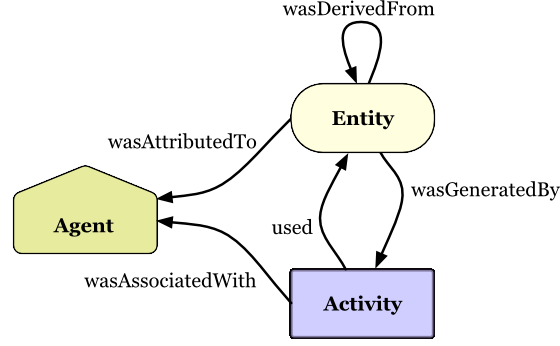
Where:
The Provenance resource actually corresponds to a single activity that identifies a set of resources (
target
)
generated
by
the
activity.
The
activity
also
references
other
entities
(
) generated by the activity. The activity also references other entities (
entity
)
that
were
used
and
the
agents
(
) that were used and the agents (
agent
)
that
were
associated
with
the
activity.
) that were associated with the activity. To record multiple activities that resulted in one (
target
), record each (
activity
) in independent Provenance records all pointing at that (
target
).
The Provenance resource depends upon having References to all of the resources, entities, and agents involved in the activity. These References need not be resolvable. The references must provide a unique and ambiguous identification. If a resource, entity, or agent can have different versions that must be identified, then the Reference must have versioning information included.
Versioning and unique identification are not mandated for all systems that provide Resources, entities, and agents. But, inclusion of Provenance requirements may introduce requirements for versioning and unique identification on those systems
At this juncture, Provenance has several areas of concern for the Security WG. The first concern is whether the current HL7 ProvenanceEvent value set is sufficient for conveying the states to which a trigger event can cause an activity to transition the FHIR Resource target of the Provenance Resource from a previous state. The current value set was will be updated post DSTU2.
While the intended FHIR ProvenanceEvent value set has sub-value sets from multiple sources such as W3C and HL7, there are some duplicate and colliding definitions, the upside is that there are more provenance event related actions than in the HL7 ProvenanceEvent value set. The Security, Community Based Collaborative Care, and the EHR Work Groups are in the process of refining and de-duplicating this value set in hopes of replacing the current one in DSTU 2.1 if the Provenance Resource is permitted to be re-published. In any case, feedback from business and implementer communities would be very much appreciated.
Another area of concern is whether the Provenance.entity.role element is necessary at all if there is a sufficient activity value set, and if it is useful, whether W3C codes indicating that the entity is the target of provenance, e.g., derivation or revision, make sense where the entity is an input into a target resource which may be a revision or derivation of that entity.
Note that the binding of the ProvenanceEvent and Purpose of Use value sets are currently set to extensible rather than example. Concerns have been raised about constraining vocabulary choices during DSTU especially for other jurisdictions. For example, outside of the US, ISO 13606 Purpose of Use codes are more likely used. Security WG would also appreciate feedback on whether these bindings should be example or extensible.
Structure
| Name | Flags | Card. | Type |

|
|---|---|---|---|---|

 Provenance
|
Σ | DomainResource |
|
|

 target
|
Σ | 1..* | Reference ( Any ) |
|
 period
|
Σ | 0..1 | Period |
|
 recorded
|
Σ | 1..1 | instant |
|
|
reason
|
Σ | 0..* |
|
PurposeOfUse |
|
activity
|
Σ | 0..1 |
|
ProvenanceEventCurrentState |
|
location
|
Σ | 0..1 | Reference ( Location ) |
|
|
policy
|
Σ | 0..* | uri |
|
 agent
agent
|
Σ |
|
BackboneElement |
|
 role
role
|
Σ | 1..1 | Coding |
ProvenanceParticipantRole |
|
actor
|
Σ | 0..1 |
Reference
(
Practitioner
|
|
|
userId
|
Σ | 0..1 | Identifier |
|
 relatedAgent
|
Σ | 0..* | BackboneElement |
|
 type
type
|
Σ | 1..1 | CodeableConcept |
|
|
target
|
Σ | 1..1 | uri |
|
|
entity
|
Σ | 0..* | BackboneElement |
|
|
role
|
Σ | 1..1 | code |
ProvenanceEntityRole |
|
type
|
Σ | 1..1 | Coding |
ResourceType |
|
reference
|
Σ | 1..1 | uri |
|
|
display
|
Σ | 0..1 | string |
|
 agent
agent
|
Σ | 0..1 |
|
|
|
signature
|
Σ | 0..* | Signature |
|
|
Documentation for this format
|
||||
UML
Diagram
UML Diagram
XML
Template
XML Template
<Provenance xmlns="http://hl7.org/fhir"><!-- from Resource: id, meta, implicitRules, and language --> <!-- from DomainResource: text, contained, extension, and modifierExtension --> <target><!-- 1..* Reference(Any) Target Reference(s) (usually version specific) --></target> <period><!-- 0..1 Period When the activity occurred --></period> <recorded value="[instant]"/><!-- 1..1 When the activity was recorded / updated -->
<</reason> <</activity><reason><!-- 0..* Coding Reason the activity is occurring --></reason> <activity><!-- 0..1 Coding Activity that occurred --></activity> <location><!-- 0..1 Reference(Location) Where the activity occurred, if relevant --></location> <policy value="[uri]"/><!-- 0..* Policy or plan the activity was defined by --><<agent> <!-- 1..* Actor involved --> <role><!-- 1..1 Coding What the agents involvement was --></role> <actor><!-- 0..1 Reference(Practitioner|RelatedPerson|Patient|Device| Organization) Individual, device or organization playing role --></actor> <userId><!-- 0..1 Identifier Authorization-system identifier for the agent --></userId> <relatedAgent> <!-- 0..* Track delegation between agents --><</type><type><!-- 1..1 CodeableConcept Type of relationship between agents --></type> <target value="[uri]"/><!-- 1..1 Reference to other agent in this resource by identifier --> </relatedAgent> </agent> <entity> <!-- 0..* An entity used in this activity --><<role value="[code]"/><!-- 1..1 derivation | revision | quotation | source | removal --> <type><!-- 1..1 Coding The type of resource in this entity --></type> <reference value="[uri]"/><!-- 1..1 Identity of entity --> <display value="[string]"/><!-- 0..1 Human description of entity --> <agent><!-- 0..1 Content as for Provenance.agent Entity is attributed to this agent --></agent> </entity> <signature><!-- 0..* Signature Signature on target --></signature> </Provenance>
JSON
Template
JSON Template
{
  "resourceType" : "Provenance",
  // from Resource: id, meta, implicitRules, and language
  // from DomainResource: text, contained, extension, and modifierExtension
  "target" : [{ Reference(Any) }], // R!  Target Reference(s) (usually version specific)
  "period" : { Period }, // When the activity occurred
  "recorded" : "<instant>", // R!  When the activity was recorded / updated
  "
  "

  "reason" : [{ Coding }], // Reason the activity is occurring
  "activity" : { Coding }, // Activity that occurred

  "location" : { Reference(Location) }, // Where the activity occurred, if relevant
  "policy" : ["<uri>"], // Policy or plan the activity was defined by
  "

  "agent" : [{ // R!  Actor involved

    "role" : { Coding }, // R!  What the agents involvement was
    "actor" : { Reference(Practitioner|RelatedPerson|Patient|Device|
    Organization) }, // Individual, device or organization playing role
    "userId" : { Identifier }, // Authorization-system identifier for the agent
    "relatedAgent" : [{ // Track delegation between agents
      "

      "type" : { CodeableConcept }, // R!  Type of relationship between agents

      "target" : "<uri>" // R!  Reference to other agent in this resource by identifier
    }]
  }],
  "entity" : [{ // An entity used in this activity
    "

    "role" : "<code>", // R!  derivation | revision | quotation | source | removal

    "type" : { Coding }, // R!  The type of resource in this entity
    "reference" : "<uri>", // R!  Identity of entity
    "display" : "<string>", // Human description of entity
    "agent" : { Content as for Provenance.agent } // Entity is attributed to this agent
  }],
  "signature" : [{ Signature }] // Signature on target
}
Structure
| Name | Flags | Card. | Type |
|
|---|---|---|---|---|
|
Provenance
|
Σ | DomainResource |
|
|
|
target
|
Σ | 1..* | Reference ( Any ) |
|
|
period
|
Σ | 0..1 | Period |
|
|
recorded
|
Σ | 1..1 | instant |
|
|
reason
|
Σ | 0..* |
|
PurposeOfUse |
|
activity
|
Σ | 0..1 |
|
ProvenanceEventCurrentState |
|
location
|
Σ | 0..1 | Reference ( Location ) |
|
|
policy
|
Σ | 0..* | uri |
|
|
agent
|
Σ |
|
BackboneElement |
|
|
role
|
Σ | 1..1 | Coding |
ProvenanceParticipantRole |
|
actor
|
Σ | 0..1 |
Reference
(
Practitioner
|
|
|
userId
|
Σ | 0..1 | Identifier |
|
|
relatedAgent
|
Σ | 0..* | BackboneElement |
|
|
type
|
Σ | 1..1 | CodeableConcept |
|
|
target
|
Σ | 1..1 | uri |
|
|
entity
|
Σ | 0..* | BackboneElement |
|
|
role
|
Σ | 1..1 | code |
ProvenanceEntityRole |
|
type
|
Σ | 1..1 | Coding |
ResourceType |
|
reference
|
Σ | 1..1 | uri |
|
|
display
|
Σ | 0..1 | string |
|
|
agent
|
Σ | 0..1 |
|
|
|
signature
|
Σ | 0..* | Signature |
|
|
Documentation for this format
|
||||
XML
Template
XML Template
<Provenance xmlns="http://hl7.org/fhir"><</reason> <</activity><reason><!-- 0..* Coding Reason the activity is occurring --></reason> <activity><!-- 0..1 Coding Activity that occurred --></activity> <location><!-- 0..1 Reference(Location) Where the activity occurred, if relevant --></location> <policy value="[uri]"/><!-- 0..* Policy or plan the activity was defined by --><<agent> <!-- 1..* Actor involved --> <role><!-- 1..1 Coding What the agents involvement was --></role> <actor><!-- 0..1 Reference(Practitioner|RelatedPerson|Patient|Device| Organization) Individual, device or organization playing role --></actor> <userId><!-- 0..1 Identifier Authorization-system identifier for the agent --></userId> <relatedAgent> <!-- 0..* Track delegation between agents --><</type><type><!-- 1..1 CodeableConcept Type of relationship between agents --></type> <target value="[uri]"/><!-- 1..1 Reference to other agent in this resource by identifier --> </relatedAgent> </agent> <entity> <!-- 0..* An entity used in this activity --><<role value="[code]"/><!-- 1..1 derivation | revision | quotation | source | removal --> <type><!-- 1..1 Coding The type of resource in this entity --></type> <reference value="[uri]"/><!-- 1..1 Identity of entity --> <display value="[string]"/><!-- 0..1 Human description of entity --> <agent><!-- 0..1 Content as for Provenance.agent Entity is attributed to this agent --></agent> </entity> <signature><!-- 0..* Signature Signature on target --></signature> </Provenance>
JSON
Template
JSON Template
{
  "resourceType" : "Provenance",
  // from Resource: id, meta, implicitRules, and language
  // from DomainResource: text, contained, extension, and modifierExtension
  "target" : [{ Reference(Any) }], // R!  Target Reference(s) (usually version specific)
  "period" : { Period }, // When the activity occurred
  "recorded" : "<instant>", // R!  When the activity was recorded / updated
  "
  "

  "reason" : [{ Coding }], // Reason the activity is occurring
  "activity" : { Coding }, // Activity that occurred

  "location" : { Reference(Location) }, // Where the activity occurred, if relevant
  "policy" : ["<uri>"], // Policy or plan the activity was defined by
  "

  "agent" : [{ // R!  Actor involved

    "role" : { Coding }, // R!  What the agents involvement was
    "actor" : { Reference(Practitioner|RelatedPerson|Patient|Device|
    Organization) }, // Individual, device or organization playing role
    "userId" : { Identifier }, // Authorization-system identifier for the agent
    "relatedAgent" : [{ // Track delegation between agents
      "

      "type" : { CodeableConcept }, // R!  Type of relationship between agents

      "target" : "<uri>" // R!  Reference to other agent in this resource by identifier
    }]
  }],
  "entity" : [{ // An entity used in this activity
    "

    "role" : "<code>", // R!  derivation | revision | quotation | source | removal

    "type" : { Coding }, // R!  The type of resource in this entity
    "reference" : "<uri>", // R!  Identity of entity
    "display" : "<string>", // Human description of entity
    "agent" : { Content as for Provenance.agent } // Entity is attributed to this agent
  }],
  "signature" : [{ Signature }] // Signature on target
}
Alternate
definitions:
Alternate definitions:
Schema
/
Schematron
,
Resource
Profile
(
, Resource Profile (
XML
,
,
JSON
),
),
Questionnaire
| Path | Definition | Type | Reference |
|---|---|---|---|
|
|
|
Extensible | PurposeOfUse |
|
|
|
Extensible | ProvenanceEventCurrentState |
|
|
|
Extensible | ProvenanceParticipantRole |
|
|
|
Example |
|
|
|
|
Required | ProvenanceEntityRole |
|
|
|
Extensible | ResourceType |
The Provenance resource identifies information about another resource (the
reference
element).
The
Provenance
resource
may
be
used
in
several
different
ways:
As
part
of
a
document
bundle
where
it
identifies
the
provenance
of
part
or
all
of
the
document
On
a
RESTful
system
where
it
keeps
track
of
provenance
information
relating
to
resources
When
used
in
a
document
bundle,
the
element). The Provenance resource may be used in several different ways:
When used in a document bundle, the
references
are
often
not
explicitly
versioned,
but
they
always
implicitly
pertain
to
the
version
of
the
resource
found
in
the
document.
On
a
RESTful
system,
the
target
resource
reference
should
be
version
specific,
but
this
requires
special
care:
For
new
resources
that
need
to
have
a
corresponding
Provenance
resource,
the
version-specific
reference
is
often
not
knowable
until
after
the
target
resource
has
been
updated.
This
can
create
an
integrity
problem
for
the
system
-
what
if
the
Provenance
resource
cannot
be
created
after
the
target
resource
has
been
updated?
To
avoid
any
such
integrity
problems,
the
target
resource
and
the
Provenance
resources
should
be
submitted
as
a
pair
using
a
are often not explicitly versioned, but they always implicitly pertain to the version of the resource found in the document. On a RESTful system, the target resource reference should be version specific, but this requires special care: For new resources that need to have a corresponding Provenance resource, the version-specific reference is often not knowable until after the target resource has been updated. This can create an integrity problem for the system - what if the Provenance resource cannot be created after the target resource has been updated? To avoid any such integrity problems, the target resource and the Provenance resources should be submitted as a pair using a
transaction
.
.
The Provenance resource includes a
signature
element
(digital
signature)
which
can
be
used
for
standards
based
integrity
verification
and
non-repudiation
purposes.
The
element (digital signature) which can be used for standards based integrity verification and non-repudiation purposes. The
Signature
datatype
provides
details
on
use
of
the
signature
element.
The
Signature.type
coded
value
of
"Source"
should
be
used
when
the
datatype provides details on use of the
signature
is
for
simply
proving
that
the
resource
content
is
the
same
as
it
was
when
the
resource
was
updated
or
created.
element. The Signature.type coded value of "Source" should be used when the signature is for simply proving that the resource content is the same as it was when the resource was updated or created.
Because the Provenance resource often refers to parties that are not represented as FHIR resources,
agent
and
and
entity
references
are
allowed
to
be
either
references
to
other
resources,
or
they
can
refer
to
other
entities
that
are
not
FHIR
resources.
For
Provenance.agent,
the
references are allowed to be either references to other resources, or they can refer to other entities that are not FHIR resources.
For Provenance.agent, the
actor
element
is
used
to
reference
an
existing
resource.
To
reference
an
entity
that
is
not
a
FHIR
resource,
the
element is used to reference an existing resource. To reference an entity that is not a FHIR resource, the
userId
element
is
used.
A
version
specific
reference
to
a
FHIR
resource
on
the
same
server:
element is used.
A version specific reference to a FHIR resource on the same server:
  <agent>
    <actor>
      <reference value="Patient/34/_history/3"/>
    </actor>
  </agent>
A
reference
to
a
user
(a
person)
not
represented
by
a
FHIR
resource:
A reference to a user (a person) not represented by a FHIR resource:
  <agent>
    <userId>
      <value value="http://acme.com/users/34"/>
    </userId>
  </agent>
For
Provenance.entity,
the
code
in
the
.type
element
is
used
to
differentiate
between
the
two
cases:
if
the
code
is
in
the
system
"http://hl7.org/fhir/resource-types",
then
the
reference
is
to
a
resource,
and
the
element
reference
functions
exactly
the
same
as
in
a
resource
reference
.
A
version
specific
For Provenance.entity, the code in the .type
element is used to differentiate between the two cases: if the code is in the system "http://hl7.org/fhir/resource-types", then the reference is to a resource, and the element
reference
to
a
FHIR
resource
on
the
same
server:
functions exactly the same as in a
resource reference
.
A version specific reference to a FHIR resource on the same server:
  <entity>
    <type>
      <system value="http://hl7.org/fhir/resource-types"/>
      <code value="Patient"/>
    </type>
    <reference value="Patient/34/_history/3"/>
  </entity>
In
effect,
this
is
the
same
pattern
as
a
standard
resource
reference,
but
the
type
becomes
extensible
to
allow
referencing
other
kinds
of
resources.
A
reference
to
a
entity
(a
person)
not
represented
by
a
FHIR
resource:
In effect, this is the same pattern as a standard resource reference, but the type becomes extensible to allow referencing other kinds of resources.
A reference to a entity (a person) not represented by a FHIR resource:
  <entity>
    <type>
      <system value="http://hl7.org/fhir/provenance-participant-type"/>
      <code value="person"/>
    </type>
    <reference value="http://acme.com/users/34"/>
  </entity>
One
subtle
issue
with
the
use
of
the
Provenance
resource
is
to
differentiate
between
whether
the
reference
is
to
the
resource
itself,
or
whether
the
the
reference
is
to
the
real
world
thing
that
the
resource
represents,
e.g.
was
it
the
person
involved
in
the
activity,
or
the
record
of
the
person.
For
agents,
it
should
be
understood
that
the
reference
is
to
the
real
world
thing
that
the
resource
represents.
One subtle issue with the use of the Provenance resource is to differentiate between whether the reference is to the resource itself, or whether the the reference is to the real world thing that the resource represents, e.g. was it the person involved in the activity, or the record of the person. For agents, it should be understood that the reference is to the real world thing that the resource represents.
A Provenance record can be recorded to indicate who Deleted a Resource. If versioning is supported, the version that was deleted is referenced in Provenance.target; if versioning is not supported then Provenance.target contains the non-version reference. Provenance.entity is not used unless there is a business requirement to do so.
Search parameters for this resource. The
common parameters
also apply. See
Searching
for
more
information
about
searching
in
REST,
messaging,
and
services.
for more information about searching in REST, messaging, and services.
| Name | Type | Description | Paths |
| agent | reference |
|
Provenance.agent.actor
( Device |
| end | date |
|
Provenance.period.end |
| entity | uri |
|
Provenance.entity.reference |
|
|
token |
|
Provenance.entity.type |
| location | reference |
|
Provenance.location
( Location ) |
| patient | reference |
|
Provenance.target
( Patient ) |
|
|
token |
|
Provenance.signature.type |
| start | date |
|
Provenance.period.start |
| target | reference |
|
Provenance.target
(Any) |
| userid | token |
|
Provenance.agent.userId |
© HL7.org 2011+. FHIR STU3 Candidate (v1.4.0-8139) generated on Thu, Mar 31, 2016 08:09+1100.
QA Page
Links:
Search
|
Version
History
|
Table
of
Contents
|
Compare
to
DSTU1
|
Version History
|
Table of Contents
|
Compare to DSTU2
|
|

|
Propose
a
change
try
{
var
currentTabIndex
=
sessionStorage.getItem('fhir-resource-tab-index');
}
catch(exception){
}
if
(!currentTabIndex)
currentTabIndex
=
'0';
$(
'#tabs'
).tabs({
active:
currentTabIndex,
activate:
function(
event,
ui
)
{
var
active
=
$('.selector').tabs('option',
'active');
currentTabIndex
=
ui.newTab.index();
document.activeElement.blur();
try
{
sessionStorage.setItem('fhir-resource-tab-index',
currentTabIndex);
}
catch(exception){
}
}
});
|
Propose a change